Consortium Members
The Lombard Security Consortium consists of 14 independent institutional members that collectively govern all critical protocol operations. Members are selected to provide organizational, geographic, and operational diversity, ensuring no single category of institution could be compromised simultaneously to threaten the protocol.
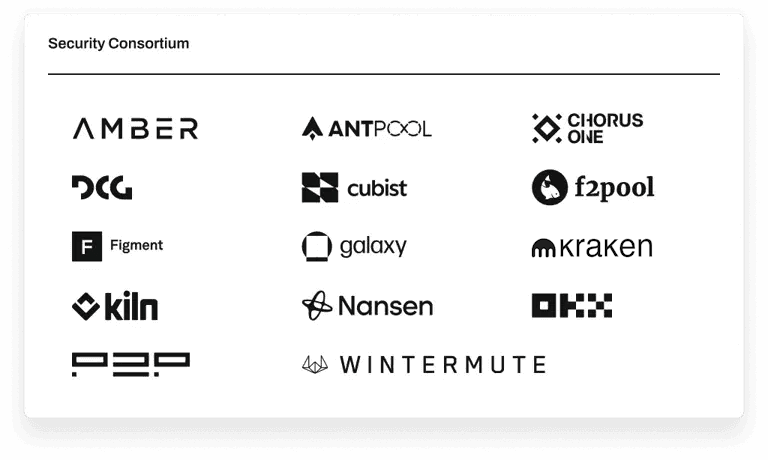
Every critical operation requires cryptographic signatures from at least 10 of the 14 members (a two-thirds supermajority). This high threshold means even the compromise of four members simultaneously would be insufficient to authorize unauthorized actions.
Members by Role
Crypto Institutions
Major digital asset firms providing institutional credibility, regulatory compliance, and operational infrastructure.
Market Makers
Algorithmic trading and liquidity firms ensuring deep market expertise and real-time operational capabilities.
Mining Pools
Bitcoin mining operations with deep understanding of the Bitcoin network, block production, and on-chain activity.
Institutional Validators
Professional staking and validator operations with experience running mission-critical blockchain infrastructure.
Security and Research
Specialized security, cryptography, analytics, and formal verification firms contributing technical rigor and independent oversight.
Membership Requirements
Joining the Security Consortium is a rigorous process that includes:
- Infrastructure deployment, Candidates must deploy and operate the required signing infrastructure
- KYB review, Know Your Business verification ensures institutional legitimacy
- Network vote, Existing Consortium members vote on new member admission
- Smart contract update, The new member’s signing keys are added to the protocol’s governance contracts
Next Steps
- Security Model, Full overview of Lombard’s defense-in-depth architecture
- Audits, Third-party security audits and continuous monitoring
- Infrastructure, How the Consortium powers protocol operations