Products Overview
Lombard is a leading Bitcoin finance protocol with $3 billion in Bitcoin onboarded. Founded in 2024 and backed by Polychain Capital, Franklin Templeton, and Binance Labs, Lombard’s products — LBTC, BTC.b, the Lombard SDK, Bitcoin Smart Accounts and Bitcoin Earn — enable Bitcoin holders, corporate treasuries, and financial institutions to earn yield on, borrow against, and deploy their Bitcoin onchain. Lombard’s infrastructure powers Bitcoin products for the users of Ledger, Binance, and Bybit, and integrates with Aave, Morpho, and 50+ DeFi protocols across 10 blockchains.
Lombard’s product suite addresses three core needs: providing the infrastructure to build with Bitcoin, representing Bitcoin onchain, and earning yield on Bitcoin.
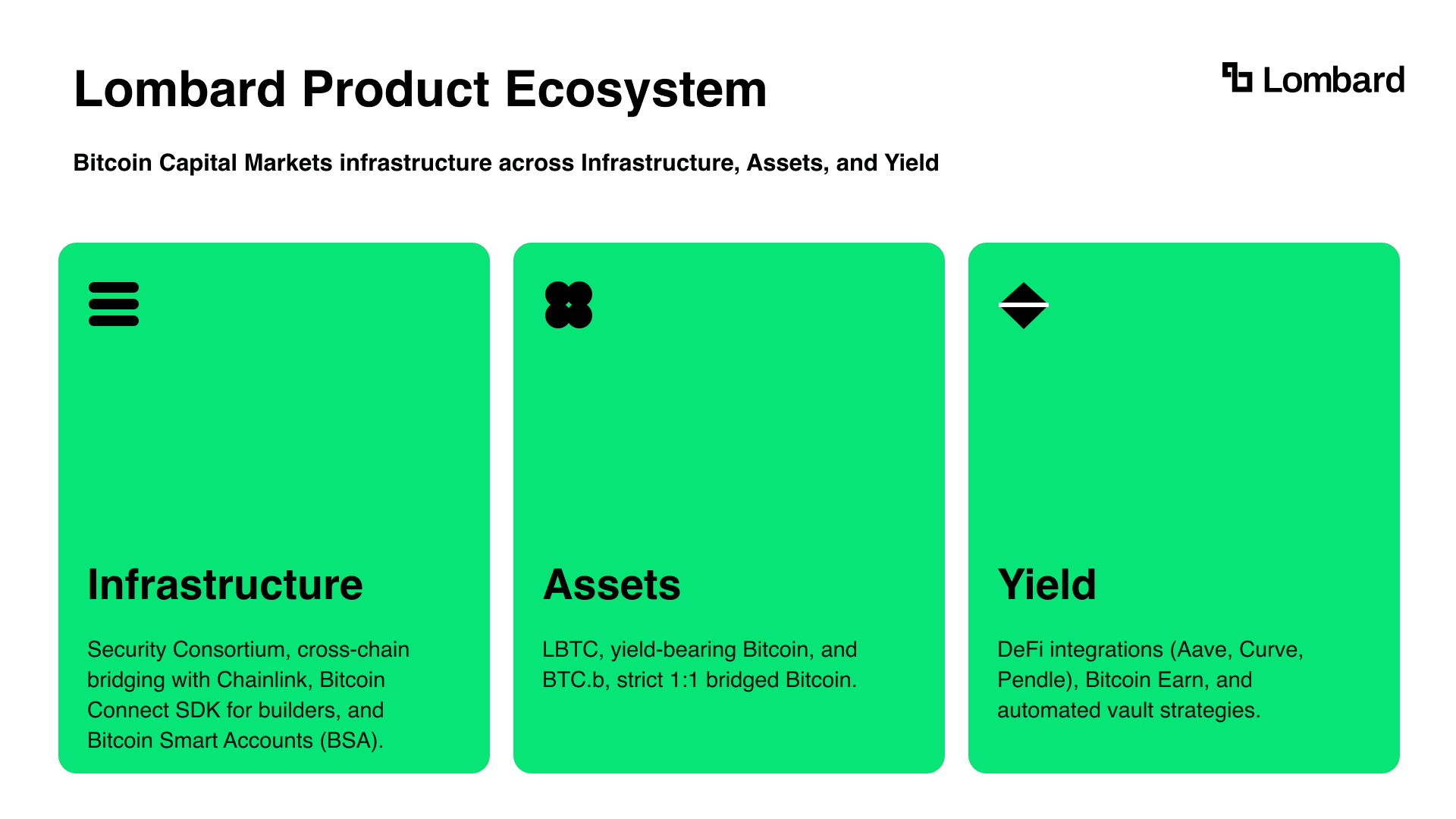
Infrastructure
Lombard’s infrastructure layer provides the security, bridging, and developer tools that power the ecosystem, including Bitcoin Smart Accounts (BSA) for institutional access to onchain finance.
Bitcoin Connect
Builder platform for integrating Bitcoin functionality. The Lombard SDK provides a deployment-ready toolkit for onchain Bitcoin products.
Bitcoin Smart Accounts
The first rail between institutional custody and onchain finance. Use custodied Bitcoin as collateral in DeFi without transferring assets out of custody.
Security Consortium
Institutional members operate the Lombard Ledger. Every critical operation requires cryptographic signatures from a supermajority.
Cross-Chain
Natively available across multiple blockchains with Chainlink-powered bridging and dual verification.
Bitcoin Connect
Bitcoin Connect is Lombard’s builder platform for integrating Bitcoin functionality into applications. Connect provides the infrastructure for minting flows, redemptions, cross-chain transfers, and portfolio tracking.
The Lombard SDK is a complete, deployment-ready toolkit within Connect for launching onchain Bitcoin products and strategies.
Bitcoin Smart Accounts
Bitcoin Smart Accounts (BSA) are the first rail between institutional custody and onchain finance. Institutions add a Smart Account designation to their existing custody account, and their Bitcoin is recognized onchain through BTC.b receipt tokens. The underlying Bitcoin never leaves the qualified custodian, and legal title and beneficial ownership remain with the holder at all times.
The architecture uses partially signed Bitcoin transactions (PSBTs) and time locks to form emulated covenants, enabling programmable locking on Bitcoin without changing custody. Each account is fully isolated.
BSA is built for asset managers, crypto funds, corporate treasuries, and high-net-worth individuals who hold Bitcoin at qualified custodians and want to access DeFi without transferring assets, surrendering control, or triggering tax events.
The first integration is with Morpho, where BTC held in custody can be used as collateral to borrow stablecoins or earn yield. A strategic partnership with Bitwise Asset Management extends BSA to additional institutional holders, with more custodians and protocols rolling out through 2026.
Security Consortium
The Lombard Security Consortium is a network of institutional members operating the Lombard Ledger, a transparent verifiable blockchain. Every critical operation (deposits, mints, redemptions, and cross-chain transfers) requires cryptographic signatures from a supermajority of consortium members. This distributed trust model ensures no single party can compromise the protocol.
Cross-Chain Infrastructure
LBTC and BTC.b are natively available across multiple blockchains. Lombard uses industry-standard bridging infrastructure, custom built with Chainlink, to enable secure cross-chain transfers. The protocol implements dual verification where both the bridge validators and the Security Consortium must approve all transfers.
Assets
Lombard issues two Bitcoin-backed tokens, each designed for different use cases.
LBTC
Yield-bearing Bitcoin token fully backed by BTC, with yield from an institutional covered-call strategy. Non-rebasing design where the exchange rate appreciates over time.
BTC.b
Non-yield Bitcoin asset with strict 1:1 BTC parity. Optimized for speed, simplicity, and predictable pricing.
Vault Shares
Automated DeFi yield strategies. Deposit into a vault and receive share tokens while the vault handles strategy execution.
LBTC: Lombard Bitcoin
LBTC is Lombard’s flagship product: a yield-bearing Bitcoin token fully backed by BTC held in institutional custody. When you deposit BTC with Lombard, you receive LBTC, a liquid token you can use across DeFi while the underlying BTC earns income from a covered-call options strategy managed by Bitwise Investment Manager, LLC, targeting 2.5% net APY in BTC terms at full deployment.
Unlike yield products that lock your assets, LBTC gives you full liquidity. You can lend it, provide liquidity, use it as collateral, or bridge it to other chains, all while continuing to earn yield.
LBTC uses a non-rebasing design. Rather than receiving additional tokens, the exchange rate between LBTC and BTC increases over time as yield accrues. Each LBTC becomes redeemable for progressively more BTC, making it straightforward to track your position’s value.
BTC.b: Bridged Bitcoin
BTC.b is a non-yield Bitcoin asset designed for users who need strict 1:1 BTC parity. Originally launched by Ava Labs, BTC.b was acquired by Lombard in October 2025 to provide a complementary product for different use cases.
Where LBTC is optimized for earning yield over time, BTC.b is optimized for speed and simplicity. The exchange rate is always exactly 1:1 with BTC, redemptions are faster, and there’s no yield mechanism to consider. This makes BTC.b well-suited for trading, short-term collateral needs, and applications where predictable pricing matters more than yield.
Together, LBTC and BTC.b give users flexibility: hold LBTC for long-term yield accumulation, or use BTC.b when you need straightforward Bitcoin representation without the yield component.
Vault Shares
Lombard Vaults provide professionally managed yield strategies for Bitcoin holders. Rather than manually deploying your Bitcoin across protocols, you deposit into a vault and receive share tokens representing your position. The vault handles strategy execution, rebalancing, and yield optimization.
Bitcoin Earn accepts multiple Bitcoin assets and allocates them across two managed strategies, DeFi money markets and institutional onchain credit. This allows holders to earn additional yield on top of LBTC’s base yield.
Yield
Lombard unlocks yield opportunities for Bitcoin through a yield-bearing Bitcoin asset, DeFi integrations, and Bitcoin Earn vault strategies.
Bitcoin Earn
Professionally managed vault accepting LBTC, BTC.b, or native BTC. Capital allocates across DeFi money markets and institutional onchain credit, and rewards auto-compound into BTCe receipt tokens.
Base Yield: Covered-Call Options Strategy
When you hold LBTC, a portion of the Bitcoin backing it (the active allocation) is deployed into a covered-call options strategy managed by Bitwise Investment Manager, LLC. Option buyers pay premiums for the right to buy Bitcoin at a set price by a set date; those premiums, denominated in BTC, are reflected in LBTC’s increasing exchange rate. The remaining backing sits in an isolated passive allocation under Security Consortium custody so redemptions are always available.
This is real market income: option premiums paid by counterparties for optionality on Bitcoin’s price, not lending, liquidity mining, or token emissions.
DeFi Integrations
LBTC is integrated across major DeFi protocols, enabling holders to compound yield through lending, liquidity provision, and restaking. You can supply LBTC to lending markets like Aave and Morpho, provide liquidity on DEXs like Uniswap and Curve, or explore yield strategies through aggregators like Pendle.
Because LBTC is an ERC-20 token available on multiple chains, it works seamlessly with existing DeFi infrastructure. The base yield continues to accrue regardless of how you deploy your LBTC.
Lux Rewards
The Lux program rewards users for deploying LBTC and BTC.b across eligible DeFi protocols.
Participants earn Lux points based on their deployment activity, which convert to BARD token allocations at each claim event.
Season 3 has now ended. It had three multiplier tiers: DEX Liquidity at 1x, Lending Collateral at 3x, and Lombard Strategies at 6x.
Eligible chains include Ethereum, Solana, Avalanche, MegaETH, and Base.
Passive holding of LBTC or BTC.b does not earn Lux.
Next Steps
- Assets, Deep dive into LBTC, BTC.b, fees, and contract addresses
- Infrastructure, Security Consortium, bridging, and oracles
- Yield, How yield works and where it comes from
- Yield Strategy, The covered-call mechanics, custody split, and risk limits
- Protocol Architecture, How Lombard’s security model works end-to-end
- Token Economics, $BARD supply and distribution
- Access DeFi, Explore DeFi opportunities with LBTC and BTC.b